Since publication of the Government's Curriculum and Assessment Review, Media and Information Literacy is being talked about more than ever. The ability to understand, interpret and create information across different media is an essential life skill for our children and young people, helping them to become responsible and informed members of society.
Ahead of our Information Book Award ceremony next week, we spoke to Chris Haughton and Loonie Park, creators of shortlisted title The History of Information to hear their thoughts on the importance of visual communication, the dangers of disinformation and how media literacy has a role to play in world peace.
Chris: Who or what sparked your initial interest in the history of information? What made you think "I need to create a book about this"? The idea came in 2006. University of California, Berkeley had announced that year they were putting all their undergraduate lectures online for free. It was the first major public university in the U.S. to share full course lectures so openly. I began to listen to some of them, psychology and philosophy and others but one course title stood out as I scrolled through: THE HISTORY OF INFORMATION.
I listened to the first lecture and the lecturer asked the class a seemingly simple question: ‘Why is technology improving?’ Why is it that next year and the next and next we can almost guarantee we will have better phones and computers. And why has this improvement in tech more or less been a feature all through history? None of the students had good answers. The lecturer finally stepped in and answered: information.
I was immediately hooked. The course was a history of ‘information technology’ but the lecturers took a wide view of the subject and considered drawing, writing and print as ‘information technologies’. It was a completely different way of looking at the world. History, as it is usually taught, is a timeline of kings and queens and events. But why is it that we had kings and queens at all? Why then all of a sudden did we abandon them and shift to democracies? Why did all the world’s religions emerge around the same time? Why are societies dominated by men? Each time the answer came down to the the same thing: information. It was so simple but explained the world so clearly.
The thing that interested me the most is that this history is connected so closely to the history of graphic design, visual communication and media studies: all the subjects that I had studied. The history of information and the history of visual communication are the same history. So it makes sense to tell the story visually, something I am well-positioned to do. Immediately I knew I wanted to make a book. A history of graphics told through graphics.
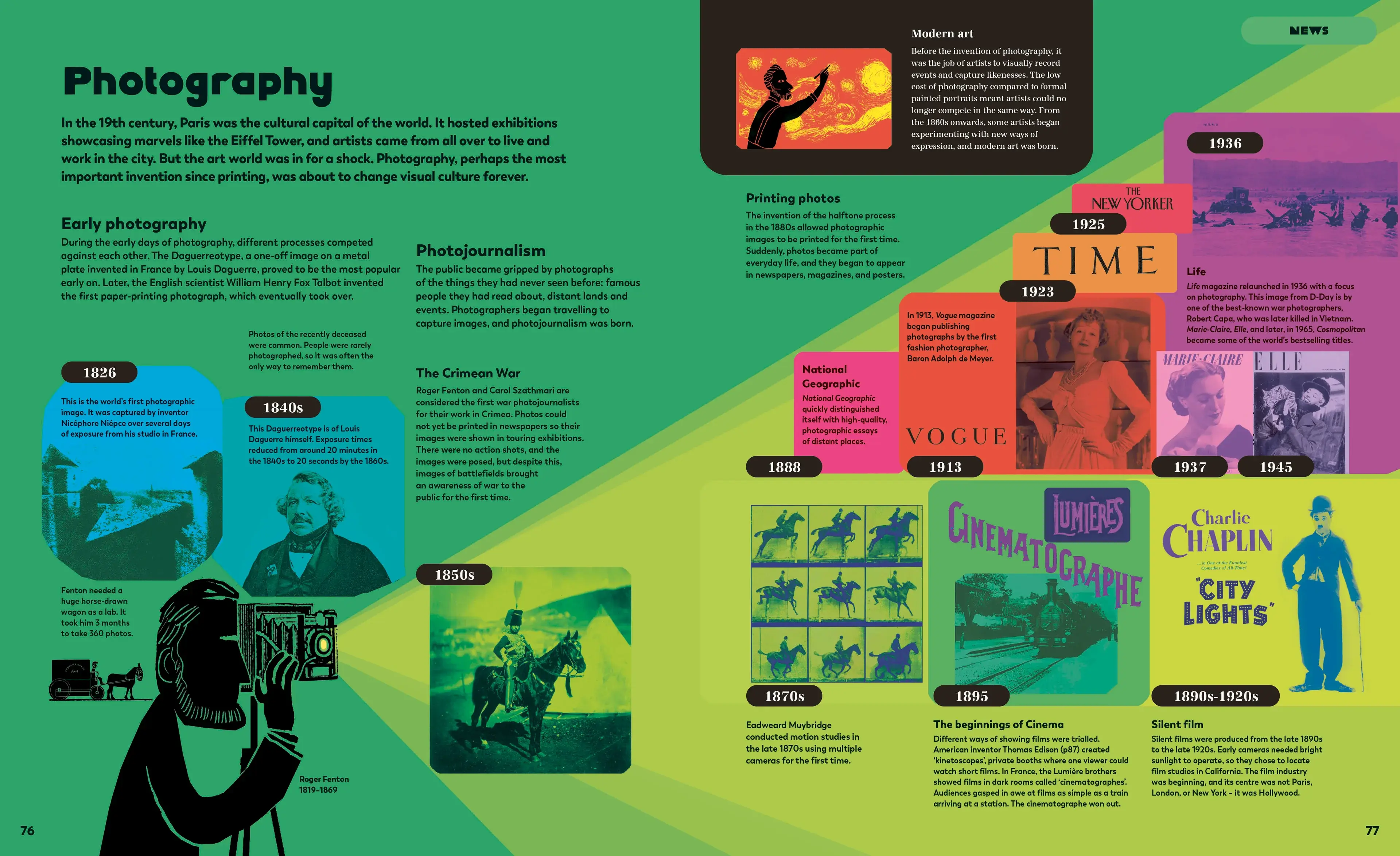
Loonie: What was the most surprising or fascinating fact you discovered while researching this book? One of the most surprising realisations I had about information technology is its role in the World Wars. For the first time, broadcasting made it possible to spread messages instantly, crossing borders and reaching millions. Radio didn’t just share news: it shaped public opinion across time and space.
During the Second World War, nearly every country involved - from France and Italy to the UK, set up radio stations to broadcast their own view of the conflict. Each promoted the idea that the war was both necessary and morally right. If you had tuned in to all those broadcasts at once, you would have heard completely different stories about the same war. It would have been enough to leave anyone unsure what to believe.
This resonates with me as someone from South Korea. The Korean War in the 1950s ended in an armistice, but the information war never really stopped. In North Korea, students are still taught that the South started the war. For decades, both sides blasted messages across the border, each claiming the other lived in misery. There may be fragments of truth on both sides, but the one thing that’s always true is that war makes everyone suffer. Information literacy can help people better understand disinformation during conflicts and push for peace.
Chris: How important do you think the images and visual elements are in information books? How do the words and pictures work together in The History of Information? I make picture books and I’m interested in telling stories through images. I studied graphics, and I approach stories the way a designer would—thinking about how meaning is shaped by layout, form, and flow. This book is really a visual history of how information has been presented over time.
We don’t always notice it, but visual messages are everywhere. They shape how we think, what we buy, how we vote and how we connect with others.
Today, we live through screens. Whether we're booking a train, ordering food or chatting with friends, we often do it through visual interfaces. A few taps on icons like likes, shares or retweets, and a message is sent. These symbols have become part of everyday life.
But this isn’t entirely new. For thousands of years, visual systems have shaped culture and power. The written word was once the main interface, especially in Europe, where the Bible played a central role. Priests held authority because they could read. Then came print, with newspapers, leaflets and posters. Then television. Each shift changed how people received information and who controlled it.
Chris: How do you decide what to show and what to leave out when illustrating information books? What's your process for making information visually engaging and accessible? The goal was not to simplify the ideas but to try to distil and clarify them. Visual storytelling plays the key role in that. That is what made me most excited about this project. The whole story is entirely visual. If you present concepts through images, they can be more understandable. But also, if done right, they remain just as complex and nuanced. It simplifies the content without reducing it. We tried to keep the depth of the material intact while using visuals to do the heavy lifting.
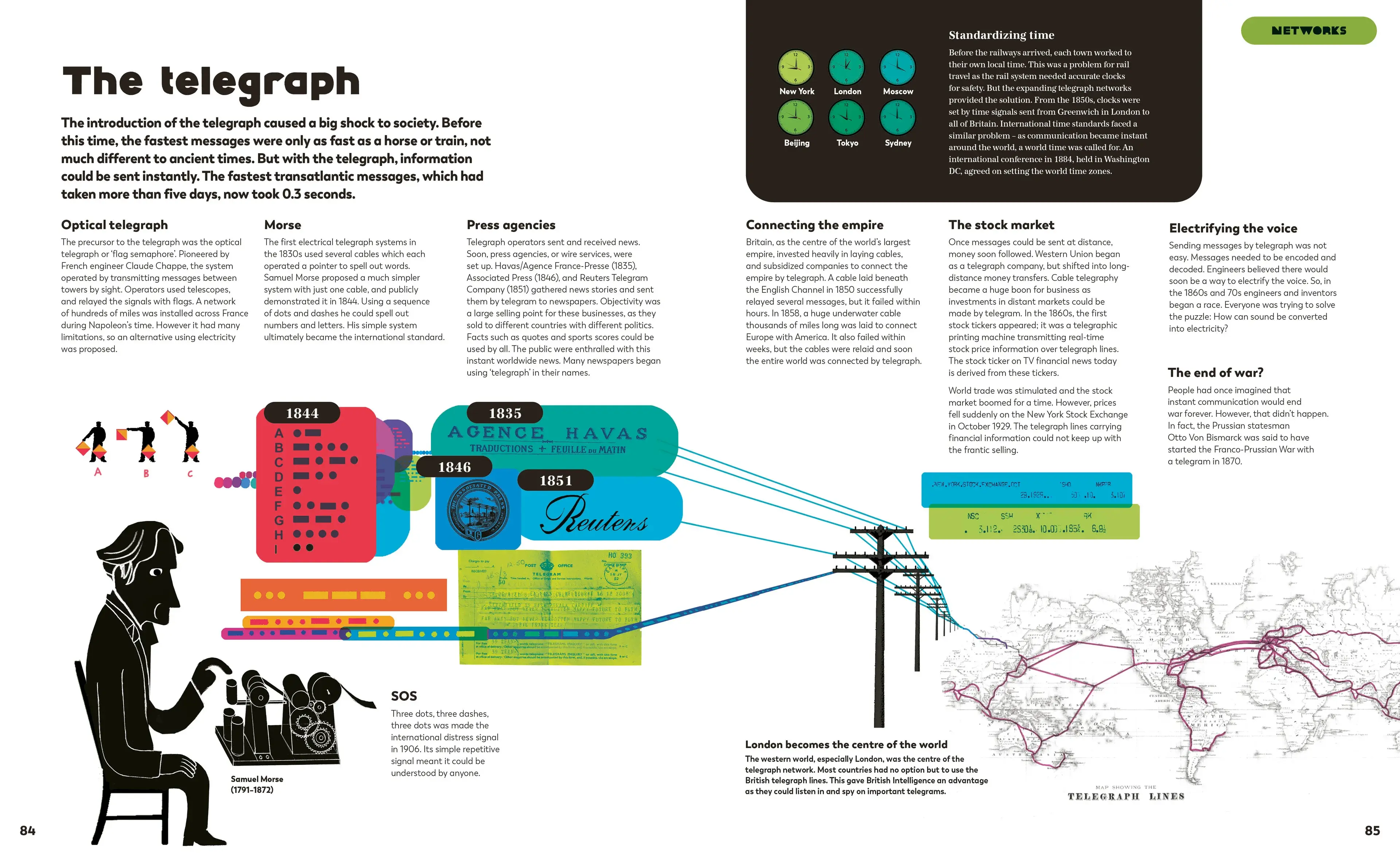
Loonie: What role do you think information books play in helping children understand and navigate the modern world? The modern world is full of information, and knowing how to value and question it is one of the most important skills for the future. It’s often called information literacy, though I like to call it 'source sense'.
Information books offer a strong foundation for learning where to find reliable facts. In the digital world, it is easy to get quick answers to everyday questions, but the real challenge is knowing whether those answers are actually true. I’ve worked in journalism for decades, and Chris has worked in media as an illustrator and is very tuned in to how information is presented, so we both understand how important it is to know where to look and how to assess the quality of information. That was one of the motivations behind The History of Information, which we created together.
Recognising valuable sources and judging information well takes time. It is a skill built gradually, not something you pick up overnight. Reading well-researched information books is one of the best ways to start.
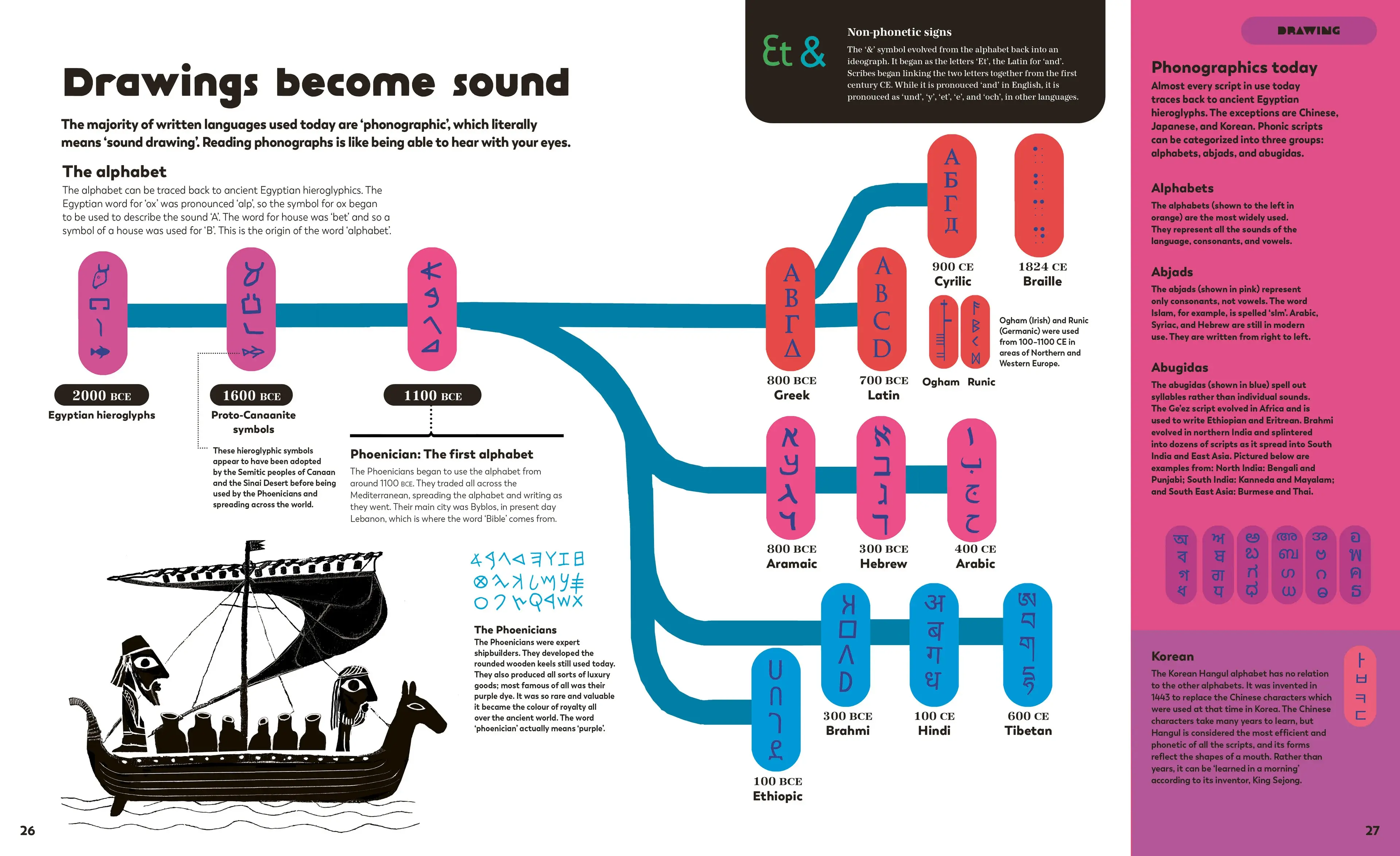
Chris: If you could add one extra chapter or section to your book, what would it cover and why? We wanted to talk about information technology from a global perspective, not just from Europe and the United States. There have been brilliant contributions from other parts of the world, such as the development of maths in ancient India. There were many small things I would have loved to include, but the book could easily have doubled or even tripled in length. We had to make some difficult choices.
We considered a page on Indian mathematics, another on the history of the poster, and even one on cinema. Each topic was fascinating, and we really liked the ideas. In the end, though, we focused on what supported the central story. Still, we have not let go of them completely. They might even inspire another book one day.
Loonie: If a young reader wanted to explore this topic further, what would you recommend they do next? Are there any places to visit, experiments to try, safe websites to explore, or other books to read? Museums are brilliant places for discovering information. They’re like treasure boxes—there’s always something new to find. The more you bring to it, the more it reveals. I’ve visited the British Museum and the Science Museum in London many times, both for research and leisure, and there are still so many hidden stories to uncover. If you live in London, those two are a great place to start. Further north, the National Science and Media Museum in Bradford offers fascinating exhibitions on the history of media and information technology, both online and in person.
Really, every museum offers something valuable. While no source is completely neutral, museums usually take a more thoughtful approach to presenting information. That makes them an excellent place to develop the habit of considering different viewpoints, asking questions, and strengthening information literacy.
Chris Haughton is an Irish designer and author living in London. He has published seven books and an app. His books have been translated into more than 30 languages and have won awards in more than a dozen countries.
Loonie Park is a former BBC Journalist now devoted to creating beautiful non-fiction books and crafting compelling stories.
We are announcing the winners of the 2025 Information Book Awards at a ceremony in London on Thursday 27th November. Keep an eye on our social channels for the announcement!
On 4th December we are hosting a free training webinar focused on media and information literacy in the school library in partnership with First News. We know school librarians are well placed to support young people to develop their skills and knowledge in this area, and we are pleased to be partnering with First News to bring you this opportunity. Book your place.