Three weeks after author Alex Wheatle's tragic death from prostate cancer, school librarian and SLA Trustee, Helen Cleaves, looks back on Alex's life and work, reflecting on his contribution, and how lucky she was to meet and work with him.
Occasionally you meet someone truly transformative. Someone who turns your world upside down. Someone who has the ability to flip a switch and show you a whole new way of walking through the world. I doubt I am alone when I say that for me, Alex Wheatle was that person.
Who could forget the story of eleven year old Alex on his first day at secondary school in a hand me down too big blazer and broken shoes; the slap-slap of the loose rubber soles on the concrete floor as he walked down the school corridor, an invitation that was too tempting for the bullies to ignore and led to Alex being expelled when he inevitably retaliated? Or the only (?) child in the care home who did not have any visitors at the weekend and, when the other children were asleep, would sneak discarded copies of Beano out of the bin to read by torchlight under the covers.
It was Alex who opened my eyes to the possibility that there are children who did not have someone to ask how their day had gone when they returned home after their first day at big school.
When it came to selling books, his own story could not be beaten. When Alex first visited my school for an author talk you could have heard a pin drop. This was not eager Year 7 pupils. This was the toughest crowd in the school: Year 9 boys.
In his own words, books literally saved his life. I will be forever grateful to Simeon, his Rastafarian cellmate in Wormwood Scrubs where Alex was sent after the Brixton Riots, who handed him CLR James' Black Jacobins when he was on the brink of suicide. Seeing himself for the first time reflected back off the page provided the seed of hope he so desperately needed, which the prison library was able to nurture and grow. Alex the reader became Alex the writer.
Alex's characters leap off the page. McKay, Naomi, Kemosha. Characters I will never forget. Reading a few pages of a Crongton book is to live in the ends where young people are permanently on the edge and one wrong move could send them plummeting into the figurative abyss never to be seen again. The energy in those books is palpable, raw, taut - everything hangs on a perpetual tightrope. Threat stalks every page.
Cane Warriors brings that potent energy, like the frenetic nothingness just before the first thunderclap of a storm, to a historical setting linked to Wheatle’s own family history.
There is also space in Alex's books for laughter, joy, music, time for a joke and a comforting meal. They may be clinging on with gritted teeth but one thing is for sure, Alex's characters know how to live. Like every minute could be their last. Because that is maybe how it feels in the worlds that Alex crafts.
Alex was gentle. Alex was the epitome of understated. He was also Tough. He was a man who wasn't afraid to turn around and face the fight. Whoever the Goliath. Be it the Carnegie medal, Shirley Oaks children's homes or Babylon.
When Alex announced his Carnegie boycott after his Guardian Book Prize winner Crongton Knights was snubbed for shortlisting, he blew up the status quo, prompting a much-needed review of the most prestigious children's book award. I was struck at the 2024 Carnegie award ceremony by the breadth of diversity on stage; the debt that Alex is owed for triggering the seismic shift which has in part led to an event in a West End Theatre both presented by and won by people from ethnically diverse backgrounds.
It was only four years ago that Alex recorded a video in our school library to launch the annual sponsored Read For Refugees, complete with a fake sunflower and his trademark rasta bag. On that occasion Alex was visiting for World Book Day when Cane Warriors was on the Carnegie shortlist.
I rarely risk 'sale or return' book supply for author visits but I knew that once they heard Alex's story, from prison to palace, no one would want to leave without a signed copy. And I wasn't wrong. We sold out three times over. Alex very kindly made the time to sign a ton of sticky labels which I shipped to his home for the extra copies I had to order after the event.
His memoir Sufferah is exceptional. It is Alex in his own words. At its heartbreaking core is the bitter truth that Alex's trauma could so easily have been prevented. While as a child he suffered brutal cruelty at the hands of the Shirley Oaks wardens, believing he had no family, his aunts lived but a few miles away, completely unaware of their sufferah nephew. I wept: in spite of this mean twist of fate Alex somehow reconciled with his dad and nurtured a family of his own.
I also laughed out loud at tales of mischievous Alex and his awkward shy attempts at dating; I revelled in the joy of music which reverberates off the page, wishing to have been in the South London clubs with Alex and his friends as they found gigs for their fledgling sound system.
Alex died before Crongton hit the small screen. Written by award-winning writer and comedian Archie Maddocks and based on Alex's series, the TV show is fresh, funny and full of life. The books' exuberant energy is perfectly translated from page to screen in the BBC production. It is packed with friendship, family, music, dancing, cool graphics, properly seasoned chicken; there is darkness and light and that nervous edge which means none of the characters can fully relax: this is Crongton after all. For me it perfectly embodies the magic of Alex. Highly recommend!
If you're not sure where to start with reading it's got to be Crongton Knights; if you're looking for a quick taster try The Humiliations of Welton Blake; for the whole story read Sufferah.
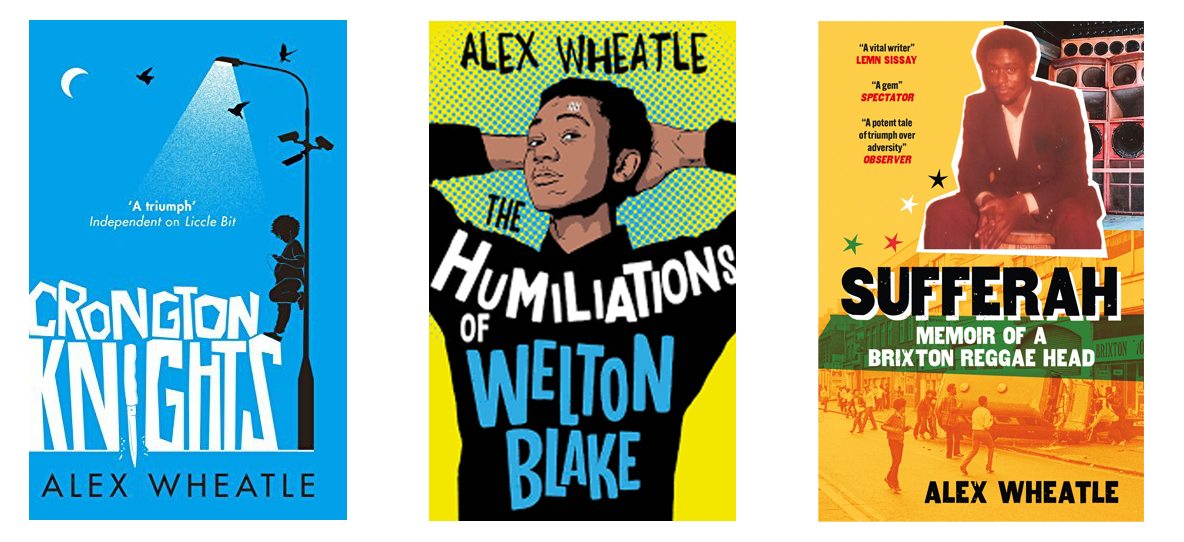
I have wept, I have laughed out loud and now I smile as I fully recognise what a privilege it was, how lucky and proud I am to say that I met and worked with Alex Wheatle MBE, the Brixton Bard, unforgettable lionheart, speaker of truth to power.